The Tree Army

The Tree Army
My wife and I watch jeopardy together daily and have a friendly competition in responding to the questions. I always hope for history related categories so when the categories are announced, I start thinking about potential history connections. A recent category was “I speak for the trees.” My first thought was the Lorax, the book by Dr. Seuss that promoted environmental awareness with the Lorax proudly proclaiming, “I speak for the trees, for they have no tongues.” The Lorax indeed was the first question in the category. The other questions were all tree related as you might expect. I had hoped for a question about the “Tree Army” but no such luck. Not that Jen wouldn’t have known the answer but because remembering the Civilian Conservation Corps that has been commonly called the Tree Army is an important chapter of our history and one we shouldn’t forget. It could even teach us a thing or two today.
The 1920s. known as the Roaring 20s for its economic prosperity, technological innovation and social change, came to a screeching halt in 1929. As the damage from the stock market collapse spread to other aspects of the economy, it was evident the country was in an economic depression. It wasn't called the Great Depression yet. Our country had experienced prior depressions. Every so often they would strike: 1837,1857,1873, 1893, 1907 and 1919. They were often short and often called panics. Another factor they had in common was the government typically didn't do anything to resolve them. That was the case in 1929 … at least in the beginning. President Herbert Hoover consistently announced prosperity was “around the corner.” Unfortunately, it was not. Stocks lost more than 80% of their value, 25% of the country was unemployed and many with jobs were part-time, more than 1,000 banks and 5,000 businesses failed yearly. It was bad.
It was so bad that Hoover took unprecedented steps on behalf of the government to aid the failing economy. Nothing worked and by 1932, the economy was worse. The 1932 election between Hoover and Franklin Roosevelt was a blowout. The only large state with more than ten electoral votes voting for Hoover was … Pennsylvania. President Roosevelt won easily (472 - 59) in part due to his proposed New Deal programs and reminding us “the only thing we have to fear is fear itself.” He introduced sixteen new legislative initiatives he wanted congress to pass to aid in recovery in his first 100 days in office. One of those laws, The Emergency Conservation Work Act, passed Congress and was signed into law March 31, 1933. I must note the law was introduced and passed by both houses in one day, unheard of today. Five days later, Roosevelt formally created the Civilian Conservation Corps that was known publicly as Roosevelt’s Tree Army. This is the program's 90th anniversary.
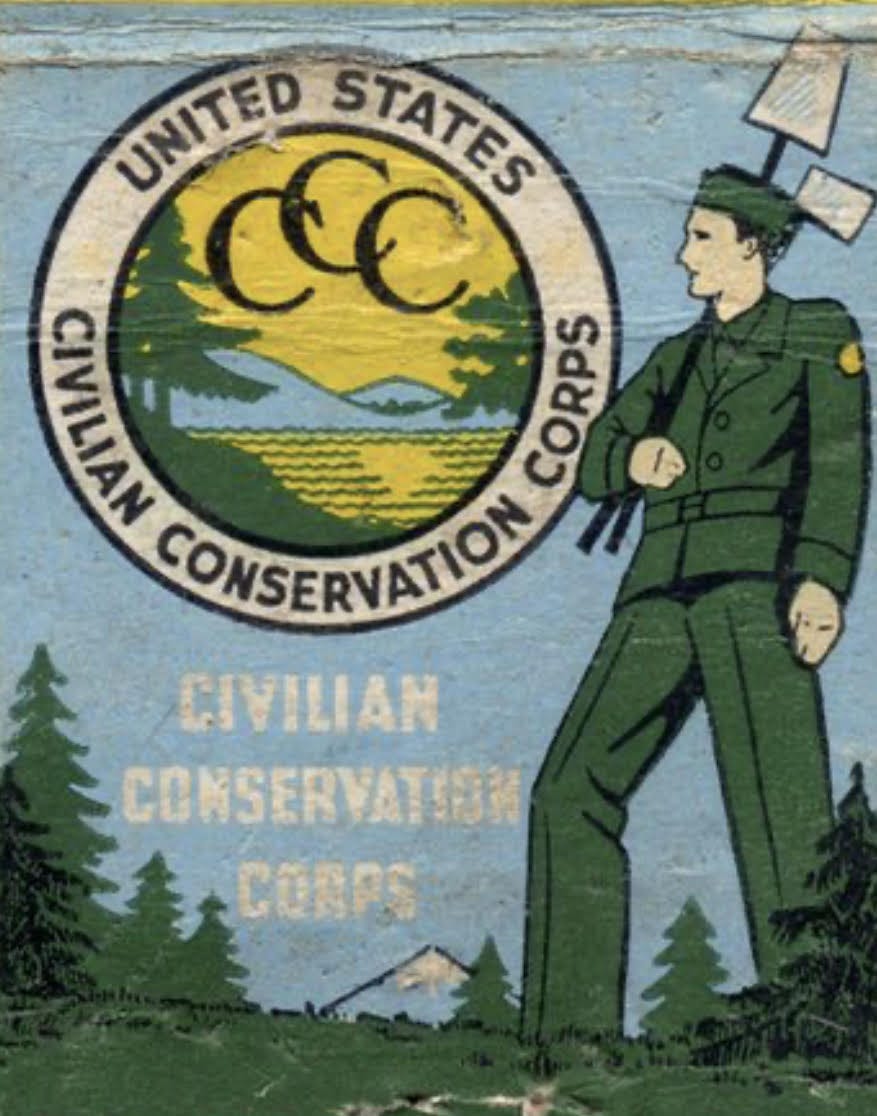
The purpose of the Civilian Conservation Corps was twofold. First to create jobs. The CCC gave jobs to single men ages 18-25 to help them and to jumpstart the economy. That age group suffered from unemployment rates higher than any other group. CCC enrollees were paid $30 a month which was basically $1 a day. Adjusted for inflation, that would be $24 a day today. $25 was sent home to their family and the men kept $5 for themselves. There was an additional employment component for veterans to be given jobs that was not limited to age 25 and they could be married or single but that was a small portion of the program. The program also employed Native Americans and African Americans. The law forbade discrimination but they were housed at different sites since segregating them was not considered discriminatory. The second goal was conservation. Members of the CCC lived at rural camps throughout the country to complete a litany of outdoor jobs. They fought forest fires, planted trees, cleared and maintained access roads, re-seeded grazing lands, implemented soil-erosion controls, and built parks, wildlife refuges, fish-rearing facilities, water storage basins, dams and animal shelters. A total of three million men were given jobs in the program between 1933 and 1942.
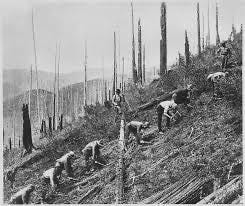
There were 2,900 camps throughout the country. The camps were operated by the army and had a military style command structure. Reveille was at 6 AM followed by roll call, barracks inspection and breakfast. Work projects were done during the day and upon completion, the men had dinner and there were classes and recreational opportunities in the evening. Many illiterate men learned to read and others even earned diplomas. Courses were also offered in vocational training. Lights out was 9pm. The enrollees served a six-month enlistment and could serve up to two years. Most of the money earned could be sent home because the enrollees lived in army style barracks and were given work clothes, one dress uniform, three meals a day and health care. Upon visiting a camp in Virginia, FDR quipped how good the food was and he would like to stay with the men but while they had gained a number of pounds, he needed to lose weight. Many camps had their own baseball and football teams as well as boxing matches. On Saturday, dances were often arranged and females from local communities were invited to the dances but despite being chaperoned, the dances were sometimes met with consternation from fathers worried about their daughters attending a dance with young men who went weeks without seeing any females. Women were not permitted to join the CCC. On Sundays, CCC trucks transported men to local churches of their choosing and Sunday night they could go to local towns and see a movie. They dare not miss their ride though as the walk back to camp was often more than ten miles.

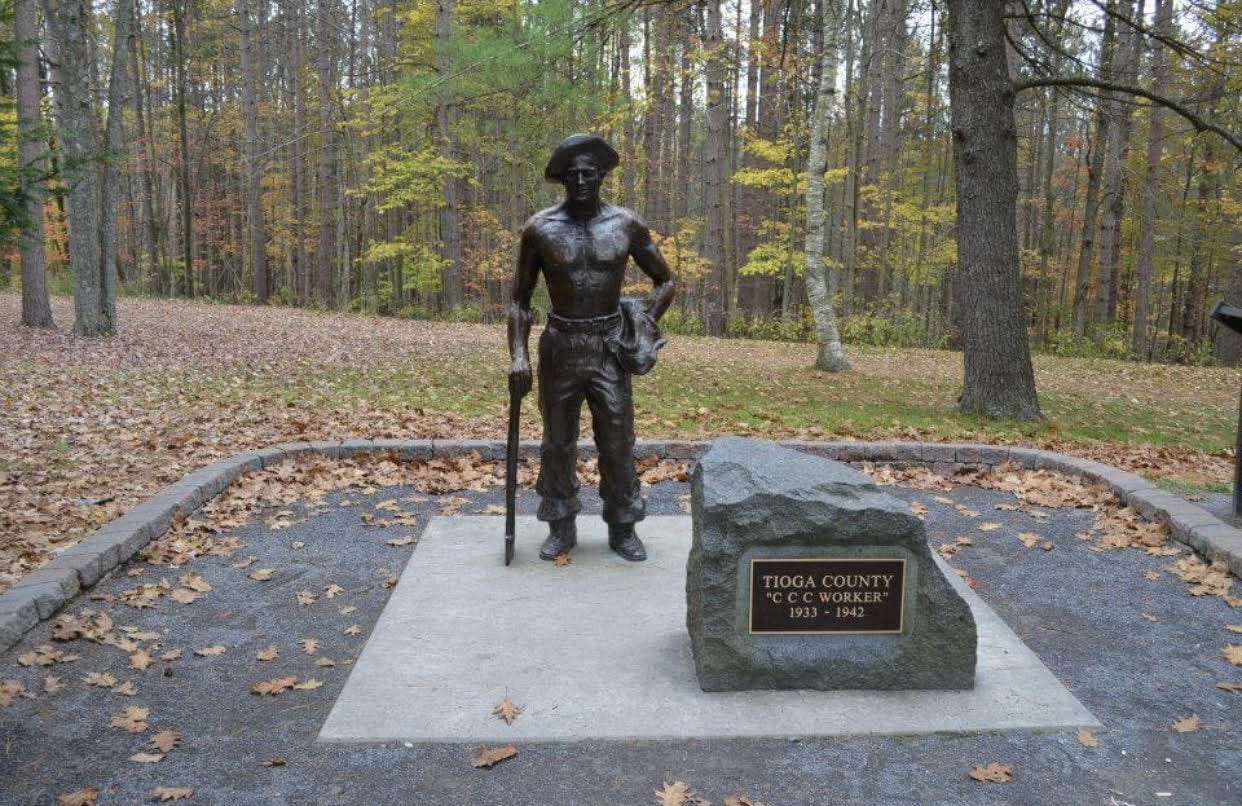
The country was divided into twelve regions for organizing the camps and nearly every city had a recruiting office. Altoona had a recruiting office and a command center that oversaw 14 nearby rural camps: Coborn, Milroy, Petersburg, Aitich, Phillipsburg, Tyler, Shawsville, Anderson, Creek, Monument, Penfield, McAlvey’s Fort, Huntingdon, Kato. There was also a camp at Blue Knob but it was assigned to another district. The Blue Knob camp built the state park there as did camps at Black Moshannon, Trough Creek, Ricketts Glen and Leonard Harrison at the site of the Pennsylvania Grand Canyon. If you visit the Pa. Grand Canyon today, there is a prominent statue of a CCC worker. If you visit Parker Dam State Park, they have a CCC museum there. If you have done outdoor activities in Pennsylvania, chances are you were taking advantage of CCC work especially if you like hiking or camping. Pennsylvania had the second highest number of camps at 141 at over 200 locations. The estimated value of CCC work in Pennsylvania was $8 billion. The same can be said if you are from another state, though my examples are from Pennsylvania, I have seen examples of CCC work in numerous other states in our travels. If you like history sites, like Gettysburg and Fort Necessity., they too benefited from the CCC work projects.
The accomplishments of the CCC during its ten years of operation were astonishing.
Three billion trees were planted.
125,000 miles of road constructed.
28,100 miles of trails opened.
80 state parks were built.
Greatly Improved National Parks.
40 million acres of land protected by erosion control.
814,000 acres of range re-vegetation.
52,000 acres of campgrounds created.
972 million fish stocked.
248,000 acres protected with mosquito control.
Countless acres saved fighting forest fires.
There are many lessons we can learn from this program. It's a fine example of a government program that worked. The benefit to the young men and their families struggling in the midst of the Great Depression was immeasurable. The long-term benefit to the United States is likely immeasurable as well. Sure you can count the items on the aforementioned list but its impact is more than numbers and still continues. One park I visited had a CCC built dam, it hasn't needed one repair in 90 years. The lessons learned from hard work is a lesson too often overlooked. This work was certainly not easy and could be labeled backbreaking. 47 brave CCC members were killed fighting forest fires but the techniques they developed are still in use today.
One could argue this type of program could be helpful today. Both an urban and rural division would benefit the country. The rural division completing similar projects while the urban division would have plenty of similar projects but focused on the needs of our cities. Our roads and highways as well as bridges, some dating to the 1930s and earlier, are in need of repair. Our state and national park rangers are understaffed and could use the help. I suppose government budgets are already inflated and funding this may be the biggest challenge. The impact though may be even greater than the first program and imagine the younger generations being more invested in their communities being involved in these projects.
In any case, the next time you are visiting a state park or national park, take a look around or ask in the visitor’s center; you are likely to find evidence of the Tree Army – the Civilian Conservation Corps.
Interesting blog. Thank you
A sign of the times that no women were permitted to serve in the CCC. :( :( :(